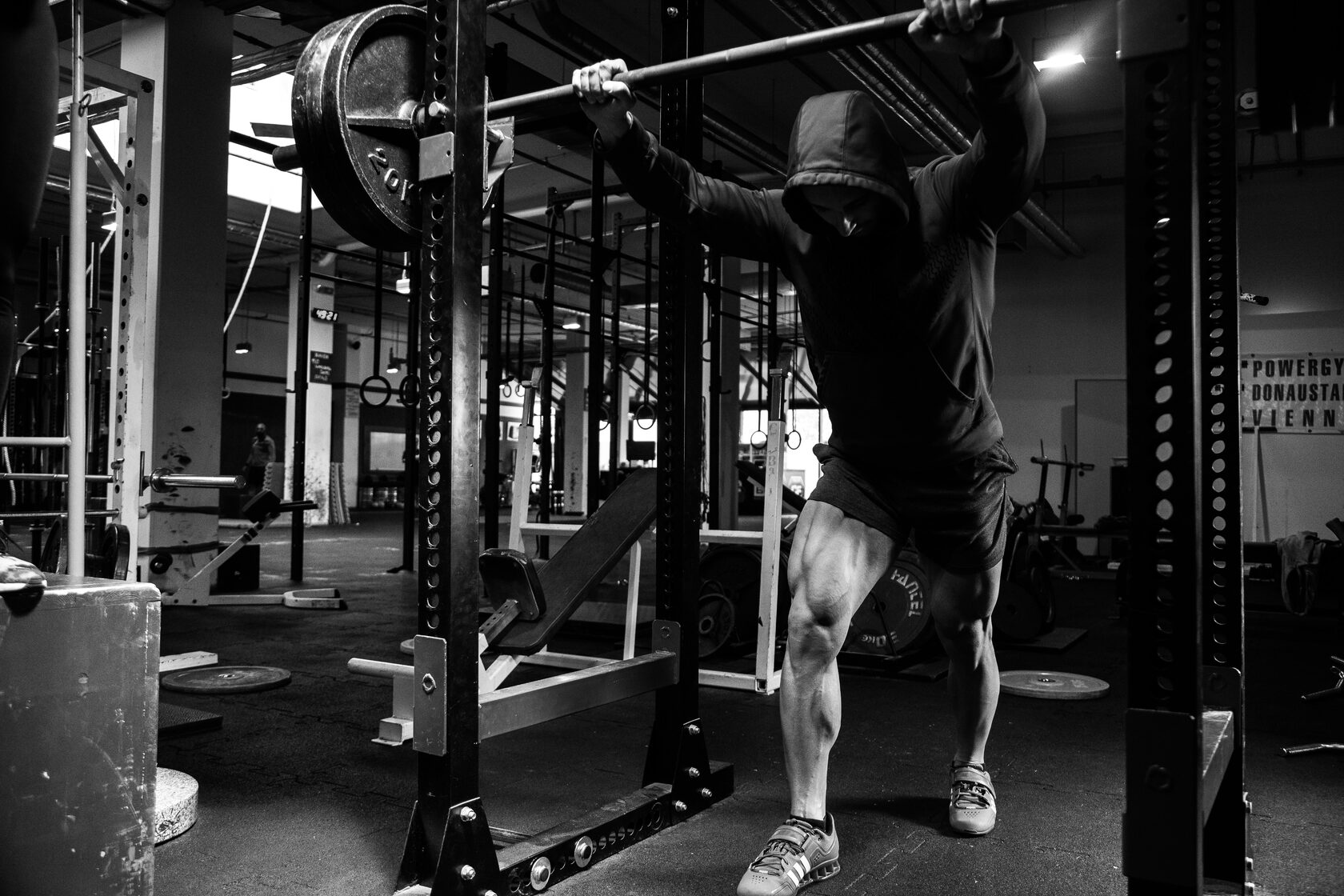
Partial movements performed in a power rack are a proven method to rapidly achieve higher levels of strength.
Strength athletes and bodybuilders have long used partials to unlock new gains in both performance and muscle growth. Even athletes in explosive sports benefit — it’s common to see world-class sprinters and jumpers perform partial squats during the preparatory or early competitive season to maximize peak performance.
History and Proven Applications
Powerlifting coach Louie Simmons achieved excellent results by integrating partial training at his Westside Barbell Club.
A variation of partial training, called isometronics, involves performing static contractions at specific points of the lift. This advanced technique was extensively used by my mentor, Charles Poliquin, with his shot putters and bobsledders.
Even earlier, weightlifters from the legendary York Barbell Club achieved remarkable improvements by combining partial range of motion with isometrics.
In bodybuilding, Mr. Olympia Frank Zane was a strong proponent of partial movements to accelerate muscle growth — his famous deadlifts from the pins were one of his secrets to developing a dense and powerful lower back.
Strength athletes and bodybuilders have long used partials to unlock new gains in both performance and muscle growth. Even athletes in explosive sports benefit — it’s common to see world-class sprinters and jumpers perform partial squats during the preparatory or early competitive season to maximize peak performance.
History and Proven Applications
Powerlifting coach Louie Simmons achieved excellent results by integrating partial training at his Westside Barbell Club.
A variation of partial training, called isometronics, involves performing static contractions at specific points of the lift. This advanced technique was extensively used by my mentor, Charles Poliquin, with his shot putters and bobsledders.
Even earlier, weightlifters from the legendary York Barbell Club achieved remarkable improvements by combining partial range of motion with isometrics.
In bodybuilding, Mr. Olympia Frank Zane was a strong proponent of partial movements to accelerate muscle growth — his famous deadlifts from the pins were one of his secrets to developing a dense and powerful lower back.
The Method of Execution
First of all, partials are not just short reps.
Because partials allow for higher loads to be lifted, they are suitable only for advanced trainees who already have a solid foundation of strength and experience with full range of motion exercises.
Key execution rules:
First of all, partials are not just short reps.
Because partials allow for higher loads to be lifted, they are suitable only for advanced trainees who already have a solid foundation of strength and experience with full range of motion exercises.
Key execution rules:
- Control the tempo — especially the eccentric (lowering) phase. You can find more about the power of eccentric here.
- No bouncing — movements must be deliberate and precise to maximize intramuscular tension.
- Smart placement — supports in the rack should be set at specific points to target weaknesses.
Breaking Through Sticking Points
A sticking point is the weakest part of a lift — for example:
By placing the support pins at the right position, partials allow you to overload exactly at the sticking point and progressively eliminate weaknesses.
A sticking point is the weakest part of a lift — for example:
- The bottom or mid-point in the bench press or squat
- The lockout of a deadlift
- The mid portion of a biceps curl or triceps extension
- The top part of a row or back extension
By placing the support pins at the right position, partials allow you to overload exactly at the sticking point and progressively eliminate weaknesses.
Training Through Injury
Another major benefit of partial movements is their usefulness during injury recovery.
According to rehab expert Carl Miller, training the pain-free range of motion and gradually expanding it not only restores strength and accelerates return to full ROM, but also provides a positive psychological effect (you can learn more on this topic clicking here), allowing athletes to stay motivated during rehab.
Another major benefit of partial movements is their usefulness during injury recovery.
According to rehab expert Carl Miller, training the pain-free range of motion and gradually expanding it not only restores strength and accelerates return to full ROM, but also provides a positive psychological effect (you can learn more on this topic clicking here), allowing athletes to stay motivated during rehab.
Drawbacks of Partial Training
Despite their benefits, partials are not a universal solution.
When misused, partials can lead to:
Therefore, partials should never be performed exclusively. They should be integrated into a well-structured program that always includes full range of motion exercises.
Despite their benefits, partials are not a universal solution.
When misused, partials can lead to:
- Excessive CNS and neurological fatigue
- Muscular imbalances between agonists and antagonists
- Higher risk of tendon and joint injuries
- Decline in technique during full range lifts
Therefore, partials should never be performed exclusively. They should be integrated into a well-structured program that always includes full range of motion exercises.
When to Use Partials
Partials are best implemented:
Used correctly, partials are a powerful tool. Used incorrectly, they can do more harm than good.
Practical Takeaways
Partials are best implemented:
- In the off-season, as part of a preparatory strength phase
- To peak an athlete for competition while managing fatigue
- As a plateau breaker for strength and hypertrophy
- During rehab, to maintain training while recovering safely
Used correctly, partials are a powerful tool. Used incorrectly, they can do more harm than good.
Practical Takeaways
- Partials are for advanced lifters with solid technique and experience.
- Always combine them with full range of motion training.
- Use them strategically: offseason strength, plateau breaking, peaking phases, or controlled rehab.
Work With Me
If you want a personalized strength or hypertrophy program that strategically integrates advanced methods like partials, isometrics, and eccentric overload, I can help you achieve your goals safely and effectively.
👉 [Apply for my 1:1 Coaching here]
If you want a personalized strength or hypertrophy program that strategically integrates advanced methods like partials, isometrics, and eccentric overload, I can help you achieve your goals safely and effectively.
👉 [Apply for my 1:1 Coaching here]
References
- McLaughlin, T. M., Dillman, C. J., & Lardner, T. J. (1977). A kinematic model of performance in the parallel squat by champion powerlifters. Medicine and Science in Sports, 9(2), 128–133.
- Simmons, L. (2007). Westside Barbell Book of Methods. Westside Barbell.
- Poliquin, C. (1997). Advanced methods in strength training. NSCA Journal.
- Zatsiorsky, V. M., & Kraemer, W. J. (2006). Science and Practice of Strength Training (2nd ed.). Human Kinetics.
- Behm, D. G., & Sale, D. G. (1993). Intended rather than actual movement velocity determines velocity-specific training response. Journal of Applied Physiology, 74(1), 359–368.
- Miller, C. (2002). Powerlifting: A Scientific Approach. Charles Thomas Publisher.